I
Recognize
Make surreptitious influence visible. Identify when ordinary persuasion begins to acquire jurisdiction over judgment.
A book about the last frontier of freedom
Recognizing, Repelling and Remedying
a Rampaging Risk
What happens when influence no longer assists judgment—but begins to displace it? Mind Theft names the danger, traces its mechanisms, and builds a practical path toward Cognitive Sovereignty.

Click or tap the cover to open the high-resolution view.
“The theft of a wallet affects what you possess; the theft of a mind affects who you become.”Kingsley Jesuorobo · Mind Theft
The central inquiry
Influence is part of human life. Capture begins when persuasion becomes deception, guidance becomes domination, belonging becomes conditional upon obedience, or authority makes meaningful questioning practically unavailable.
Drawing upon law, history, philosophy, psychology, politics, religion, technology, and everyday experience, Mind Theft examines the conditions under which beliefs are formed, protected, and revised.
Its purpose is neither cynicism nor isolation. It is the recovery of accountable trust: the capacity to question, compare, revise, refuse, and decide.
Make surreptitious influence visible. Identify when ordinary persuasion begins to acquire jurisdiction over judgment.
Understand and resist the forces that exploit fear, identity, language, authority, information, belonging, and certainty.
Strengthen awareness, critical thinking, courage, and humility—and reclaim Cognitive Sovereignty.
In distinguished voices
Five perspectives introduce the book’s central inquiry and its significance across public life, technology, culture, professional judgment, and personal freedom.
In Mind Theft: Recognizing, Repelling, and Remedying a Rampaging Risk, Kingsley Jesuorobo tackles the rapidly emerging and currently the most dangerous, existential threat to modern-day society: The undermining of critical, independent thinking and its catastrophic implications for human welfare. Mr. Jesuorobo introduces the concept of mind theft to describe the replacement of critical, independent thinking with mindless acceptance and blind conformity, a phenomenon that undermines the constructive processes that shape our motives, choices, and actions as we navigate the everyday circumstances of life and contend with issues that profoundly threaten social harmony and personal well-being. The book describes how replacing thoughtful, individual information-processing with mindless acceptance and blind conformity renders people vulnerable to the destructive influences they might otherwise resist were they to consider carefully the premises on which they are based and/or the harmful consequences they can produce.
Mind Theft introduces new concepts to describe this destructive phenomenon. It delineates the mechanisms by which the problem exerts its effects and provides a theory that outlines how these mechanisms operate in concert to inhibit independent, critical thinking. Cognitive capture is introduced as the process responsible for mind theft. The process limits critical thinking by shaping the narratives on which people rely to understand the world. Deception is often used to accomplish this end and to facilitate the acceptance of exploitative manipulations. Fear, too, is often elicited to ensure compliance. Social pressure represents a closely allied mechanism that can induce or maintain mind theft by coercing people to preserve identity and self-esteem by adopting standards and conforming to practices they might otherwise reject were they consider them carefully. Cognitive capture and manipulation are facilitated by efforts to capitalize on ignorance (i.e., gaps in knowledge) thereby undermining confidence in one’s own judgement. Reliance on authority similarly inhibits critical thinking and facilitates manipulation.
Western society is rife with examples of the ways in which mind theft has taken hold and in which it has shaped our thinking, motives, and actions—for the worse. A classic example involves the violation of human rights by dehumanizing targeted social groups through propaganda, fear, intimidation, and draconian policies. Mr. Jesuorobo introduces Nazi Germany’s efforts to eliminate the world’s Jewish population as an especially powerful example of this process. Current targeting of undocumented US immigrants and the callous, violent, and capricious methods employed to capture and deport them reflect a modern-day example of the pernicious effects of mind theft by denying the targeted group’s dignity and violating its civil rights.
Propaganda, half-truths, disinformation, and outright lies by world leaders and other government officials reflect another example of mind theft and its implementation. These tactics have become routine in shaping public attitudes and in justifying policies and practices that would otherwise be considered unpalatable, if not completely unacceptable (e.g., promoting unprovoked war; justifying punitive trade practices against trusted allies and partners; and undermining confidence in the integrity of election outcomes). Leaders’ unsubstantiated, erroneous criticisms undermine public confidence in an independent press as a source of valuable, unbiased information that can prevent or, at least, facilitate resistance to mind theft. This, in turn, renders the populace more vulnerable to manipulation and exploitation.
Conspiracy theories are often vigorously espoused and they, too, facilitate tolerance and acceptance of policies and actions that would likely be recognized as ill-considered and self-defeating were the populace encouraged critically to consider the evidence on which they are based and the deleterious long-term implications of their impact. Conspiracy theories often justify prejudice-based discriminatory practices. The notion that a small, powerful Jewish group controls world finances and government policies, for example, is a long-held belief that is often cited in justifying antisemitic violence and discrimination. The notion that the CIA is responsible for the assassination of President Kennedy represents another long-standing conspiracy theory that undermines respect for the rule of law and order. Similarly, the widely held belief that the events of 9/11 were orchestrated by the US government as a pretext to wage war on Afghanistan undermines respect for the integrity of elected officials and democracy. Despite the questionable logic and unverified claims on which such theories are based, mind theft renders them credible to a sizeable proportion of the populace because they are accepted without question. It thus renders people more vulnerable to manipulation and exploitation.
Prejudice and discrimination render people more likely to accept disinformation and to tolerate social injustice, especially when it is consistent with existing belief systems. The notion that refugees and immigrants deplete national resources by taking away jobs from existing citizens and/or that they drain economic resources by overburdening social-welfare and other government programs is often cited, for example, in support of proposals to limit the numbers accepted into a country when, in fact, experience in Canada, at least, indicates that refugees consistently contribute more (e.g., in the form of taxes paid and jobs created through new business ventures) than they take from the host country (e.g., in terms of social welfare payments or healthcare expenses). Despite unequivocal evidence that lesbian, gay, bisexual, transgender, and queer people are law-abiding, socially responsible citizens, who contribute valuably to society, on the whole, homophobia and discrimination contribute to profound hardship and suffering by limiting their opportunities to live freely and to participate fully in society (e.g., in the workforce, in accessing healthcare, and in participating in the political process).
Peer pressure, disinformation, fear, and groupthink are responsible for the mindless acceptance of incomplete, faulty evidence and contribute to devastating consequences for public health. Vaccine hesitancy and the resulting rise in preventable communicable diseases, such as measles, for example, reflect especially unfortunate consequences of misguided health behavior motivated by good intentions, but misdirected as a result of mind theft. Body shaming—i.e., criticizing, mocking, or humiliating someone based on their body shape, size, or appearance—is another, especially destructive example of the consequences of mind theft that disproportionately affects women and youth, often resulting in catastrophic outcomes (e.g., low self-esteem, depression, and even suicide). So-called “cancel culture,” (in which accusations of impropriety are sufficient to convict one in the court of public opinion), too, is a recent and particularly destructive manifestation of mind theft that undermines individual rights and social justice.
In each of these cases, thoughtful, independent, and critical evaluation of the evidence and the full significance of the issues are obscured by mindless acceptance of biased or unsubstantiated claims, social pressure, prejudice, and/or discrimination. Blind compliance with destructive, punitive actions harms individuals and diminishes society. Moreover, many of these factors operate in concert with each other, compounding the problems and rendering their deleterious effects all the more resistant to prevention.
Mr. Jesuorobo notes that although this book describes mind theft as it operates at the individual level, it also produces destructive consequences at a far greater scale, extending to larger collectives, such as organizations (e.g., trade unions), social institutions (e.g., laws and governments), and even to society at large (e.g., religious groups and even nations).
Indeed, the misuse of power at high organizational levels, such as governments, can facilitate mind theft through many of the mechanisms outlined in this work (e.g., crafting language to facilitate persuasion and the acceptance of questionable ideas, limiting available information, promoting propaganda, and exerting social pressure). A number of social institutions can be complicit in mind theft and in facilitating compliance (e.g., religion; politics; education; culture, and tradition). Technology, and especially social media, provide powerful means to enhance mind theft by undermining independent, critical thinking and thereby facilitating compliance with externally imposed policies and practices that do not serve the best interests of the individual or society.
Mind Theft concludes with a proposed remedy to these problems. This includes cultivating awareness of the influences exerted by narratives, emotions, identities, incentives, and environments as they affect judgment and compliance to authority at both the individual and collective levels. Promoting critical thinking is proposed as crucial to preventing and resisting cognitive capture. Exercising courage to act responsibly and to resist agents of cognitive capture (e.g., social pressure, fear, and intimidation) are noted as essential to overturn the pernicious effects of mind theft. The book concludes by identifying cognitive sovereignty as the ability to think critically and independently despite pervasive influences to undermine it. It rightly concludes that this is essential to living a free, independent, and satisfying life.
Mind theft has been employed as a means to influence and oppress people throughout the ages, but in our times it reflects a rising—and extremely dangerous—threat to human welfare and well-being. Modern-day leaders and industrialists have discovered that mind theft is a powerful means to manipulate and exploit the public. The implementation of tactics to achieve this appear to be increasingly sophisticated and commonplace. Mind Theft’s effort to elucidate and counteract these trends is thus extremely timely in bringing this problem to our attention and in offering a path to help society promote freedom and harmony. Will it succeed in achieving much-needed individual and societal change? This will depend on the willingness, resolve , and persistence of society to implement and maintain it. We must hope that it will.
Gerald M. Devins, Ph.D., C.Psych.
Consulting & Clinical Psychologist
Toronto, Canada
* Dr. Gerald M. Devins holds a Ph.D. in Clinical Psychology from McGill University and is a Registered Psychologist in Ontario. He has been in independent practice since 1982 and, since 1996, has conducted psychological assessments of more than 10,200 individuals.
Dr. Devins served as Professor of Psychology at the University of Calgary and Professor of Psychiatry at the University of Toronto. He was also Head of Supportive Care Research at the University Health Network and a Senior Scientist at the Centre for Addiction and Mental Health and Princess Margaret Cancer Centre. His scholarly work examines stress, coping and the influence of culture on the psychosocial impact of disease.
He has held senior editorial positions in leading scholarly journals and chaired peer-review committees for major Canadian research-funding agencies. His honours include election as a Fellow of both the Canadian and American Psychological Associations, several national career awards, and the Canadian Association of Psychosocial Oncology’s Lifetime Achievement Award.
A Canadian scholar, Marshall McLuhan, it was, who first alerted our minds to the possibility of a “global village” in which electronic media would compress perceptions of time and distance and reorganise human relationships. The futuristic world he envisioned in two seminal works—The Gutenberg Galaxy: The Making of Typographic Man (1962) and Understanding Media: The Extensions of Man (1964)—has become an increasingly recognisable reality, as digital technologies place vast streams of information within immediate reach.
For example, GSMA Intelligence's The Mobile Economy 2026 reports approximately 8.8 billion wireless connections and 5.8 billion unique mobile subscribers—roughly 70 per cent of the world's population. That connections so heavily outstrip unique subscribers reflects, among other things, the use of multiple gadgets, subscriptions and SIM cards by individual users. The scale remains extraordinary: digital connection has become an ordinary condition of modern life.
While such ubiquity of technology undoubtedly affords humankind immense utility, increasingly noticeable, however, is the pressure being exerted upon the plurality of values that once delineated peoples and cultures around the globe. The daily bombardment of our individual spaces with information—often unsolicited—can become, in a way, a snare to trap our minds.
In the process, we are increasingly confronted with the subversion of truth by opaque or manipulative algorithmic systems and the attempted redefinition of truth and lies. Added to the maelstrom is the rapid expansion of Artificial Intelligence, capable of producing persuasive synthetic material at scale. It is not impossible to distinguish what is real from what is silicon-generated, but verification has become more necessary and, at times, more difficult.
This challenge is precisely what Kingsley Jesuorobo has identified with forensic precision and addresses with clinical dexterity in Mind Theft. Essentially, it is an inquiry into the dark recesses of human psychology in general and the social conditions of influence in particular. It is also an objective audit of the sociological, cultural, political and technological enablers of cognitive capture.
Among the earliest casualties, according to the author's argument, is critical thinking. What follows is the rise of individuals who, having ceded independent judgment, are led by impulse rather than inquiry. In a typical online community, for instance, influence is determined hardly by reason, but by passion.
Empathy, on the other hand, is often regarded as a basis of our social skills. Research associated with Giacomo Rizzolatti and his colleagues suggests that mirror-neuron systems may contribute to action understanding and certain aspects of empathy, although the extent of that contribution remains debated. The broader point is sound: people do not reason as isolated machines. Emotion, identification, imitation and belonging affect how messages are received and how communities respond.
Little wonder then that, in the emerging world, bare-faced demagogues are able to incite communities into violence with hate speech. As we saw in the invasion of the Capitol in the United States in January 2021, social-media networks amplified election falsehoods and assisted the mobilisation and coordination of participants. It would be too simple to assign the event to social media alone, but equally mistaken to ignore the role of digitally reinforced narratives in creating urgency, grievance and collective certainty.
Taken together, it can therefore be seen that we have entered an age where a trend may be set merely by the quantum of approving reactions from the anonymous, not necessarily through a process of scientific validation or interrogation. Counting more on the ferocity and persistence of expression, opinion often now seeks to displace facts, even when the facts are planked with empirical evidence. More and more people are getting seduced by the charms of emotion rather than the power of empiricism.
This is the existential danger Jesuorobo is alerting humankind to in the pages ahead with uncommon clarity. But the achievement of the book lies equally in its restraint: it does not describe every influence as theft, every strong belief as capture or every disagreement as proof of manipulation.
Notably, this intervention can be said to further the debate stirred in 2022 by Max Fisher with his provocative book, The Chaos Machine, which examines how social-media platforms and engagement-driven algorithms can exploit psychological vulnerabilities, intensify extreme opinions and sometimes encourage extreme action. The difference here is that Mind Theft widens the inquiry beyond technology, locating digital manipulation within a larger architecture of fear, authority, identity, culture, love, information and power.
The difference here is that Jesuorobo does not continue the lamentations. In a language ornate with poetic cadence, he goes ahead to outline coping strategies to respond to these growing concerns, with a view to helping us better defend our individual sovereignties—whether cognitive or cultural.
* Louis Odion, a respected Nigerian journalist and multiple award-winning columnist, is the Executive Commissioner (Operations) of the Federal Competition and Consumer Protection Commission (FCCPC) in Nigeria.
Long before algorithms began mapping our neural pathways or digital echo chambers started harvesting our attention, humanity was already fighting for control of the human mind. The struggle to govern one’s own consciousness—to keep hold of our judgment and choice—isn’t a modern product of Silicon Valley. It’s an ancient battle.
If you want to understand what’s really at stake in Mind Theft, look at what uncaptured minds are capable of building. Think of the intellectual legacy of Timbuktu, where hundreds of thousands of manuscripts in science, law and philosophy proved what African intellectual self-determination looks like when fully realised. Or look at the Benin Empire—a civilisation whose governance, urban planning and metallurgy were built on sheer strategic genius and mental discipline. These were not random historical high points; they were the achievements of sovereign intellects.
But history is just as clear about how easily that sovereignty can be stripped away.
Frantz Fanon showed us the true anatomy of colonial psychology: the point where the captive mind begins enforcing its own imprisonment. Aimé Césaire warned us about the dehumanising machinery that disarms a people intellectually before taking everything else. And as Mind Theft points out so clearly, material theft almost always starts with cognitive capture. Before you can exploit a person, a community or a nation, you first have to capture how they perceive reality.
Reclaiming that perception, as Cheikh Anta Diop spent his life demonstrating, demands an uncompromising restoration of historical truth and personal consciousness.
That is why this book matters right now.
Across these twenty-eight chapters, Mind Theft gives us both the diagnosis and the cure. It lays out the exact mechanics of how our judgment gets hijacked—by fear, authority, identity and technology—and hands us a practical framework for taking it back. It treats critical thinking not as an abstract academic exercise, but as a daily act of courage and self-defence.
The scholars of Timbuktu and the builders of Benin understood something we are in danger of forgetting: the ultimate citadel isn’t made of stone. It’s the human mind. Surrendering it to manipulators, outrage machines or algorithms is surrendering our freedom.
Don’t just read this book as an analysis of modern influence. Use it as a guide to guard your mind, sharpen your judgment and reclaim your sovereignty.
* Dr. Joan Osa Oviawe is a global educationist, scholar, and public administrator known for leading major education-sector reforms in Nigeria. Her career spans academic research, consulting, and global advocacy in educational policy, technology integration, and development across multiple continents.
Most thefts leave something missing. A wallet is gone. A house is empty. But another kind of theft leaves no visible gap. The person still speaks, works, loves, worships, and votes. What quietly disappears is their ability to form their own judgment.
Kingsley Jesuorobo calls this Mind Theft. It does not mean all influence is harmful. Parents teach, experts advise, traditions guide, and communities shape us. Mind Theft begins when influence replaces judgment and weakens our ability to question, reconsider, refuse, and choose.
A free mind can be wrong, while a captured mind can sometimes be right. The real test is whether a belief can still be examined.
This matters in a world where information is everywhere, attention is for sale, and algorithms shape what we notice. Control rarely appears as control. It often comes disguised as certainty, belonging, protection, expertise, love, or moral duty. No one is immune.
This book does not blame one religion, political party, culture, ideology, or technology. It asks everyone, including the author and reader, to examine their own vulnerability to mind pickpockets.
After exploring how influence can become control, Kingsley offers a remedy: Cognitive Sovereignty. This is the ability to learn from others without giving up responsibility for what we believe and choose.
Four practices support it: awareness, critical thinking, courage, and humility. Together, they help us notice influence, test ideas, resist pressure, and remain open to evidence.
This is ultimately a book about responsibility. Our freedoms are incomplete if we can no longer examine the beliefs behind our choices. The final frontier of freedom is the mind.
The work begins with one question:
Who owns my mind?
Belong without being possessed. Trust without surrendering your judgment. Learn without treating any conclusion as final.
The most valuable thing you own is your mind.
Keep it.
Niyi Obembe (askniyi)
* Niyi Obembe is a senior project and process management professional with extensive international experience in business transformation deployments across China, Vietnam, Thailand, Spain, Italy, Denmark, Austria, Poland, Singapore, Mexico, Canada, the USA, Brazil, South Africa, and Australia. He specialises in master data management and digitalisation within Animal Health and Human Pharmaceuticals.
He is a certified SAP AG professional and holds a Postgraduate Diploma in Business Information Technology from Keele University, as well as a certificate in Digital Marketing Strategies: Data, Automation, AI & Analytics from Northwestern Kellogg.
Based in Germany, Niyi is an alumnus of KPMG LLP, Deloitte Touche Tohmatsu, Accenture, and Hewlett Packard.
Man: “You are a beautiful woman.”
Me: “I know that. Kindly tell me what I do not know,” I replied, smiling.
My daughter: “Mummy, be kind! Say thank you. The man just paid you a compliment.”
Me: “No, my dear daughter, he told me what I already know, and I mean no pun at all. I prefer conversations that educate me. He has not done that, and I am honest enough to tell him so.”
My daughter: “And of course, Mummy, you are free to answer as you wish. He made his own judgment and voiced it.” She smiled while the man in question kept looking at us, lost for words.
Me: “Just as I made my own judgment too, and chose to say it out aloud in response—or should I have kept my mouth shut? My dear daughter, the mind should not be silenced, and neither should yours.”
This real-life conversation above happened at a dinner event I attended with my daughter. It brought into view a freedom more intimate than the ability to speak: the freedom to form, examine and express one's own judgment. Few possessions are more fundamental to human dignity than the capacity to think for oneself.
We speak often of freedom of speech, freedom of religion, freedom of association, political freedom and economic freedom. Constitutions protect many of these liberties. Laws establish boundaries around them. Institutions are created to defend them. Yet beneath them lies another freedom: the freedom to form, examine, revise and own one's judgment.
What happens when that freedom is gradually displaced?
What happens when a person still speaks, but the assumptions behind the speech were implanted by another? When a citizen votes, but has been taught to fear the alternatives? When a believer obeys, not because conscience has examined the command, but because questioning has become spiritually dangerous? When a consumer desires something because an algorithm has learned precisely how to manufacture that desire? When a child mistakes inherited assumptions for discovered truths? When a professional defends an institution even when evidence contradicts it because identity has become inseparable from belonging?
And perhaps the most uncomfortable question of all: How much of what we call independent thought is actually independent? Kingsley Jesuorobo's Mind Theft begins in this uncomfortable territory. It is a book about influence, but it is not simply a book about persuasion. Human beings have always influenced one another. Parents influence children. Teachers influence students. Religious traditions influence believers. Governments influence citizens. Friends influence friends. Lovers influence one another. Books influence readers. Societies influence their members.
Influence is not inherently oppressive. Indeed, civilisation itself depends upon it. The more difficult question is what happens when influence crosses an invisible boundary—when it ceases merely to inform or persuade and begins to displace the individual's capacity to question, compare, revise, refuse and decide. Jesuorobo gives this phenomenon a name: Mind Theft. The phrase is deliberately arresting—heavy, even. It suggests that something belonging to us can be taken without our immediate awareness. Yet the author is careful not to reduce the concept to literal coercion or conspiracy. The displacement may occur gradually—socially, emotionally, intellectually or technologically. It may be produced by another person, a group, an institution, a system or, sometimes, by mechanisms operating within us.
This is what makes the concept intellectually significant. This book asks us to look beyond the visible outcome of influence and examine the architecture beneath it. Why did the person believe? Why did the person trust? Why did the person stop questioning? Why did an alternative explanation become unthinkable? Why did disagreement become betrayal? Why did fear become evidence? Why did repetition become truth? Why did belonging become more important than accuracy? And at what point did the individual cease to experience the surrender of judgment as surrender at all? Taking my case in the opening conversation as an example, apply these questions to my thinking process—not to label affirming influence as Mind Theft, but to examine how deeply repeated messages can enter identity.
These questions place Mind Theft in conversation with a remarkable body of intellectual work.
The philosophical problem is ancient. In Plato's Apology, Socrates defends the examined life. Plato's allegory of the cave explores the distinction between appearance and reality: human beings may mistake shadows for the whole of reality when the conditions of perception remain unquestioned. Immanuel Kant understood enlightenment as emergence from self-incurred intellectual dependence. John Stuart Mill defended individuality and dissent because a society that silences disagreement risks confusing conformity with truth. Mind Theft extends these enduring questions into the psychological, institutional and technological conditions of the modern world.
In today’s world, a human being does not merely live among ideas. The contemporary human being, in 2026, lives inside information environments, whether they seek to or not. Our beliefs are formed through conversations, families, schools, news organisations, religious communities, political movements, entertainment, advertising, social-media platforms, search engines and increasingly sophisticated artificial-intelligence systems. The question is therefore no longer simply whether someone has access to information. The deeper question is: Who structures the environment through which information reaches us? In my case, who shaped the repeated messages through which my belief about myself became familiar and enduring?
This distinction is crucial. The possession of information does not automatically produce knowledge. Knowledge does not automatically produce understanding. Understanding does not automatically produce wisdom, and none of these necessarily produces independent judgment. The distinction between data, information, knowledge and wisdom becomes particularly important in an age of extraordinary informational volume and velocity. Abundance can therefore coexist with ignorance. Indeed, abundance can sometimes conceal ignorance. A person overwhelmed by information may become more dependent upon whoever determines which information deserves attention. In this sense, the modern problem is not simply censorship through the removal of information. It may also be attention capture through the multiplication, prioritisation and emotional organisation of information. This is where Mind Theft enters the territory explored by scholars of propaganda, mass communication and critical theory.
Walter Lippmann examined the relationship between public opinion and the “pictures in our heads” through which people comprehend a world too complex to experience directly. Edward Bernays explored organised persuasion and the engineering of consent. George Orwell, through fiction and essays, examined the relationship between language, power and thought. Michel Foucault investigated the relationship between knowledge, discourse and power, including the ways societies establish what may be said, known and treated as normal. These traditions differ considerably, yet they converge upon an important insight: power operates not only through what people are forced to do, but also through what they come to perceive as true, normal, possible or desirable. My daughter’s expectation that I should respond to a compliment in a conventional way offers a small illustration of the social norms that shape conduct. The insight lies close to the heart of Mind Theft.
The book's six-stage Mind Theft Cycle—vulnerability, narrative introduction, emotional attachment, identity integration, defensive reinforcement and behavioural capture—offers a practical vocabulary for thinking about how cognitive capture may develop over time. It is not presented as a clinical diagnosis, and no single stage proves that capture has occurred. Its importance lies partly in its refusal to portray manipulation as an instantaneous event. Ideas are often sown and repeated. A story is introduced. An emotion becomes attached to it. The story begins to explain personal experience. The explanation becomes part of identity. Contradictory evidence becomes threatening or unpalatable. The individual begins defending not merely an idea, but the identity constructed around it. Eventually, behaviour follows belief. At that point, the person may not experience themselves as controlled at all; they may experience themselves as freely choosing. This observation brings Mind Theft into dialogue with cognitive psychology.
At this point, I will answer the question that may be in every reader’s mind: How did I come to hold the firm and unshakable belief that I am beautiful—so much so that another person’s affirmation is neither news to me nor a source of excitement? It began when my father, of blessed memory, sowed the idea. From as far back as my memory serves me, at about three years of age, he would enter my room and wake me daily with the words: “Wake up, Loretta, my beautiful daughter. It is a bright new day, and you are the most beautiful creation of God—the finest and kindest soul God has ever made.” These wake-up eulogies, repeated with remarkable consistency for nearly two decades, introduced and sustained the story.
Whenever I came home with friends, my father would reinforce how beautiful and worthy I was. Happy emotions became attached to this narrative, and it became a foundation of my self-esteem and identity. The taunts of school bullies could not easily dislodge it. I developed formidable self-confidence and self-esteem the size of a cathedral, without experiencing myself as controlled at all. Reading Mind Theft caused me to revisit that formation with new questions. Yet the book reserves Mind Theft for influence that materially displaces meaningful judgment. What my father gave me is better understood as powerful identity-forming influence—beneficial in much of its effect, yet still instructive because it shows how repeated messages from a trusted authority can become embedded before a child possesses the capacity to examine them.
The human mind is not the perfectly rational calculating machine imagined in some simplified accounts of decision-making. Robert Cialdini's work identifies recurring principles through which human beings may be persuaded, while Stanley Milgram's experiments examined obedience under perceived authority. The meaning and limits of those experiments remain debated, and neither body of research establishes that human beings are helpless. Their more useful lesson is this: our judgment operates under identifiable pressures and conditions. What can be understood may be recognised. What can be recognised may sometimes be interrupted. What can be interrupted may sometimes be resisted. This movement—from vulnerability towards awareness—is one of the most important contributions of Mind Theft.
The author's concept of Cognitive Sovereignty is therefore especially compelling. Cognitive Sovereignty does not mean believing nobody. It does not mean rejecting experts. It does not mean becoming permanently suspicious. It does not mean treating every institution as corrupt, every tradition as oppressive or every unfamiliar idea as false. Such a position would merely replace one form of intellectual dependence with another. Cognitive Sovereignty is more demanding. It requires the capacity to participate consciously in the influences shaping one's mind while retaining responsibility for one's judgment. That distinction matters enormously. Human beings necessarily depend upon other human beings for knowledge. No individual can independently verify every scientific discovery, understand every legal system, master every medical discipline or investigate every historical event. Modern civilisation depends upon epistemic trust—the practical necessity of relying upon people and institutions possessing knowledge we do not personally possess. The challenge is not to eliminate trust. It is to make trust accountable, proportionate and revisable. Authority becomes dangerous when its influence is insulated from scrutiny. The same principle applies to education.
Education can liberate the mind, but it can also reproduce intellectual conformity when learning becomes synonymous with memorising approved conclusions rather than developing the capacity to interrogate them. The true test of education is therefore not merely: What have you been taught? It is also: What have you learned to do with what you have been taught? Can you question it? Can you defend it? Can you revise it? Can you distinguish evidence from assertion? Can you recognise uncertainty? Can you change your mind without experiencing intellectual death? These questions resonate with Paulo Freire’s critical pedagogy and its contrast between passive reception and critical consciousness. They also recall advice my father gave me—advice I recommend to readers: “Never be afraid to interrogate processes or to seek answers. It is neither a sign of rudeness nor of dissidence. Never be afraid to be the left-handed person in a right-handed world.”
The same tension appears in the chapters on culture and tradition. Every human being is born into an inherited world. We receive names, languages, stories, rituals, moral assumptions, expectations and definitions of belonging before we possess the intellectual tools to evaluate them. Culture performs an indispensable function by giving the individual an initial map of reality. But a map is not the territory, and an inherited map may contain wisdom as well as error. Cultural sovereignty offers a useful middle ground between unquestioning traditionalism and indiscriminate rejection. Mature minds need not despise their inheritance in order to examine it, nor preserve everything inherited merely because it is old. They can ask: What should we preserve? What should we reform? What should we relinquish? The same principle applies to religion.
Jesuorobo recognises religion as one of humanity's most powerful sources of meaning, morality, solidarity and hope. Yet wherever profound trust meets concentrated authority, questions of Cognitive Sovereignty inevitably arise. The tragedy of Jonestown demonstrates how devotion, isolation, dependency, fear and charismatic authority can interact with devastating consequences. The lesson should not be reduced to an indictment of religion. It concerns what may happen when human vulnerability, concentrated authority and dependency converge.
The principle extends to politics. Political life is a contest among competing visions of society. Political actors seek to persuade citizens, and citizens seek to persuade one another. Narratives, symbols, identities and emotions are unavoidable components of democratic politics. But democracy requires more than the freedom to choose; it requires citizens capable of thinking while choosing. McCarthyism illustrates how fear can constrict political judgment. Contemporary digital environments introduce a different but related challenge: personalisation can tailor information to the individual, while algorithmic systems influence what receives attention. Citizens may therefore be influenced without encountering an obvious propagandist.
The messenger may be invisible, the mechanism automated, the message individually customised and the influence disguised as entertainment, convenience or relevance. Technology therefore represents one of the most important frontiers of the book's argument. The Cambridge Analytica controversy drew attention to the use of personal data and psychological profiling in political communication. The expansion of artificial intelligence raises broader questions about recommendation, persuasion, synthetic content, automated decision-making and the capacity of machines to adapt communication to individual patterns of vulnerability.
The central question is no longer simply whether technology can influence us. It can. The more consequential question is what happens when technology learns how each person is most susceptible to influence. That question deserves serious examination without technological hysteria or naivety. Technology can expand autonomy and manipulate attention; democratise knowledge and amplify misinformation; personalise education and personalise persuasion. Technology alone does not settle the moral question. Governance, design, transparency, incentives and human agency matter. So does the individual mind. This is why the author's treatment of language is important.
George Orwell's insight that political language can obscure rather than clarify remains relevant, but language manipulation is not confined to politics. Every institution develops terminology. Every profession creates categories. Every community develops concepts of inclusion and exclusion. Words do not merely describe reality; they help organise how reality is perceived. A euphemism can soften responsibility. A label can simplify complexity. A metaphor can illuminate or conceal. A repeated phrase can become an assumption. When language determines in advance what may be thought, the boundaries of vocabulary may become boundaries of imagination. Mind Theft repeatedly returns the reader to the question of who owns the frame through which reality is interpreted.
The book's exploration of love carries the argument into its most intimate territory. We often imagine manipulation as something done by strangers, governments, cults or propagandists. Yet some of the deepest forms of influence occur inside relationships characterised by trust. Love opens the mind because intimacy opens the self. That vulnerability can produce profound growth, but it can also be exploited. Healthy love permits two people to remain persons. Coercive control gradually makes one person's autonomy conditional upon the other's approval. A relationship should allow transformation without demanding surrender. Perhaps this is the deepest thread running through Mind Theft: human beings must be capable of being changed without being conquered. We cannot live, learn, love, govern, educate or build societies without influence. The objective cannot be an influence-free human being. It must be conscious participation in influence. Here, Mind Theft moves beyond diagnosis and towards responsibility.
The book does not merely ask us to identify manipulators; it asks us to examine ourselves. That is perhaps its most uncomfortable invitation. It is easy to recognise propaganda when it is directed at someone else, groupthink in another political party, manipulation in another religion or ideological capture in another community. It is considerably harder to ask: Where might my own thinking be captured? What beliefs do I defend because they are true—and which do I defend because they are mine?
Which opinions have I examined? Which did I inherit? Which did I adopt because people I love hold them—or because people I fear possess power over me? Which beliefs would I struggle to surrender because too much of my identity has been built around them? Most importantly, what evidence could persuade me that I am wrong? A mind with no answer to these questions may possess certainty without sovereignty. Intellectual freedom requires not merely the accumulation of confirming evidence, but willingness to expose one's ideas to possible refutation.
John Stuart Mill's defence of dissent reminds us that even an unpopular or mistaken opinion can perform an intellectual service by forcing prevailing beliefs to justify themselves.
The sovereign mind is not the mind that is always right. It is the mind that remains open to reflection and correction. Cognitive Sovereignty is compatible with error; indeed, it requires acknowledgement of the possibility of error.
A person convinced that they can never be wrong has surrendered an essential condition of learning. Humility is therefore not the opposite of sovereignty, but one of its foundations. The sovereign mind can say: I may be wrong. I may not have the whole story. I may have inherited this assumption. Emotion may be shaping my conclusion. I may be defending my identity rather than examining evidence. I may need to change my mind. These are not declarations of weakness. They are instruments of intellectual freedom. In this respect, Mind Theft belongs to a long tradition of works concerned with emancipation—from Plato's cave to Kantian enlightenment, from Mill's defence of individuality to contemporary scholarship on cognitive bias, social identity, behavioural influence, propaganda and digital persuasion.
Yet the book is not merely a synthesis of those traditions. Its distinctive contribution is a unifying vocabulary through which readers can examine cognitive capture across fraud, fear, ignorance, authority, identity, language, information, propaganda, groupthink, religion, politics, education, culture, love and technology. These are interconnected terrains of influence. Fear may reinforce identity. Identity may protect propaganda. Propaganda may exploit language. Language may legitimise authority. Authority may reinforce groupthink. Groupthink may suppress information.
Information asymmetry may enable fraud, while technology may amplify every stage. The resulting system can become so integrated that the individual no longer knows where influence ends and personal judgment begins. This is why the conversation matters. The capacity to influence human cognition is expanding faster than many ethical, legal and institutional frameworks. Artificial intelligence can generate persuasive language at scale. Digital platforms can personalise information. Behavioural data can reveal patterns of attention. Political communication can be micro-targeted. Commercial systems can optimise engagement. Communities can form across geographical boundaries within seconds.
None of these developments is inherently malevolent, but each increases the importance of understanding the relationship between influence and autonomy. The question of the future is therefore not whether human beings will be influenced. They will.
The question is whether they will remain sufficiently conscious of that influence to retain meaningful ownership of their choices. That is the challenge Kingsley Jesuorobo places before us. It is not reserved for politicians, religious leaders, educators, corporations, technologists or intellectuals. It is personal. It belongs to every reader.
Perhaps the greatest strength of Mind Theft is its refusal to position the reader safely outside the problem. There is no "them" without an "us." No manipulator is entirely immune from manipulation. No society possesses perfect cognitive immunity. No ideology has uniquely vulnerable adherents while everyone else remains rational. No institution can permanently outsource judgment, and no author—including the author of this book—is exempt from error. That recognition transforms Mind Theft from an accusation into an intellectual discipline. The reader is invited to ask: How does capture occur? Why does it work? What makes us vulnerable? How do we recognise and interrupt it? How do we recover? How can individuals and institutions make cognitive freedom more resilient? The answers require education, evidence, institutional transparency, freedom of inquiry, intellectual humility, diverse perspectives, protected dissent, accountable authority and responsible technology. They also require citizens who understand that freedom is not merely the absence of physical chains. Some of the most consequential chains are invisible: fear, unquestioned assumptions, identity, dependency, manufactured certainty and information we never learned to interrogate. Mind Theft asks us to see those chains and advances Cognitive Sovereignty as a framework for reclaiming responsibility for judgment.
That sovereignty will never be absolute. No human being is independent of culture, language, relationships, history, biology, institutions or circumstance. The goal is responsible autonomy: not the absence of influence, but awareness of it; not rejection of authority, but accountable trust; not destruction of tradition, but examined inheritance; not refusal to belong, but belonging without surrender; not certainty, but courage to revise; not suspicion of everything, but scrutiny of what matters.
Furthermore, Jesuorobo dissuades us from entertaining the illusion that we can think entirely alone. He asks us instead to nurture the capacity to think with others without surrendering the responsibility to think. That is a worthy aspiration. It is also a necessary one because a society may survive the loss of wealth. It may recover from political upheaval. It may rebuild institutions. It may replace governments. However, when a people lose the capacity to question the narratives governing their reality, recovery becomes much more difficult. The defence of the human mind is therefore not merely a personal project. It is a civic responsibility. It is an educational responsibility. It is a legal and institutional responsibility. It is a technological responsibility and, above all, it is a human responsibility.
The pages that follow invite us into that responsibility. Read them not merely to identify minds that may have been captured around you; rather, read them to examine your own mind. Question the author. Question the arguments. Question the evidence. Question your assumptions. Question even the questions. If, somewhere along the journey, you discover that an idea you once considered unquestionably yours was inherited, manufactured, emotionally protected or never properly examined, do not regard that discovery as defeat. Rather, see it as the beginning of freedom. I have found in this book that the ultimate purpose of examining Mind Theft is not to create minds that cannot be influenced. It is to cultivate minds that can participate in influence without surrendering ownership of judgment. That is the promise of Cognitive Sovereignty, and that is the journey this book invites us to undertake. It is my prayer that every reader emerges not merely better informed, but more difficult to deceive; not less trusting, but more discerning; not less open, but more conscious; and, above all, more fully the owner of his or her own mind. Do the world a favour—read this book and tell a friend to tell a friend to read it too. Like me, they may find that it helps us understand ourselves, improve ourselves and elevate society.
* Dr. Loretta Oduware Ogboro-Okor
Pioneer Director General of the Edo State Diaspora Agency
Consultant Obstetrician & Gynaecologist
MRCOG (United Kingdom), MBBS (Benin), MSc Public Health Research (Edinburgh)
MSc Clinical Education (Sheffield Hallam)
PhD in Law and Criminology, ongoing (Helena Kennedy Centre for International Justice, Sheffield Hallam)
Author of My Father's Daughter
Co-Founder and Co-Chair, AshantiGraham Health and Education Initiative Foundation (AGHEIF)
Director, AshantiGraham Meducators (AGM) and Loretta Health Initiative (LHI)
"Our shared humanity is the true religion."
From the book
Why I Wrote This Book
The idea behind this book emerged from a simple observation: human beings passionately defend their right to hold opinions, yet comparatively little attention is given to how those opinions are formed. Many people speak confidently about what they believe. Few pause to ask why they believe it. Fewer still ask who benefits from those beliefs.
Throughout my life as a lawyer, writer, observer, and student of human behaviour, I have repeatedly encountered situations where intelligent people appeared to have surrendered ownership of their reasoning processes. Some did so through fear; others through hope, loyalty, ideology or trust.
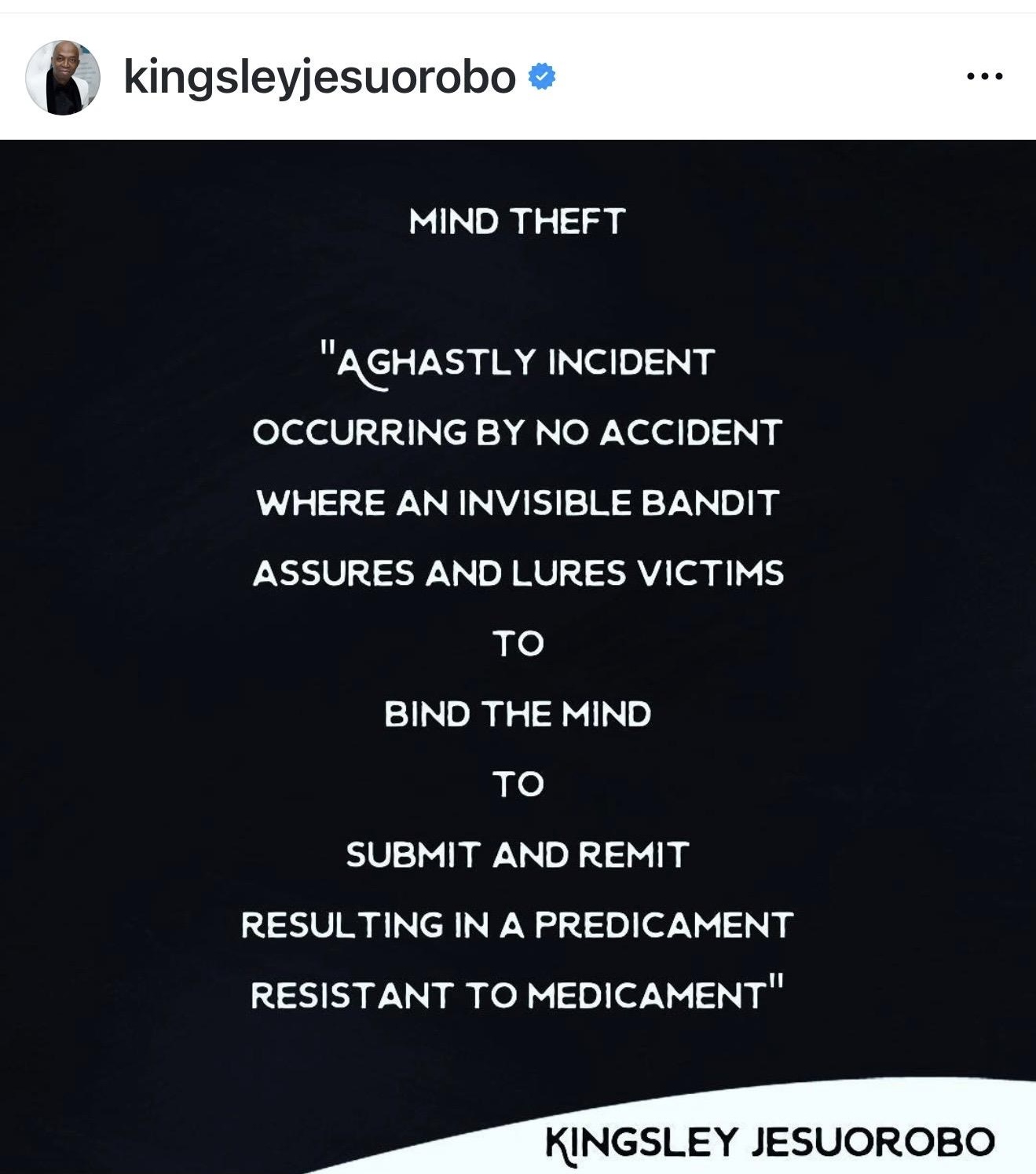
The phenomenon has fascinated me for many years. On January 6, 2019—long before this manuscript took shape—I shared an early formulation of Mind Theft on my Instagram page:
That post expressed, in poetic form, an idea that continued to occupy my thoughts: that an unseen influence may bind the mind, induce submission and leave its consequences resistant to correction. The present book represents the development of that early insight into a more comprehensive examination of how independent judgment may be captured, manipulated, surrendered and reclaimed.
The more I reflected upon the phenomenon, the more convinced I became that society lacked a sufficiently comprehensive framework for discussing this form of cognitive vulnerability. This work is my attempt to provide such a framework.
The concept of Mind Theft is not intended as an accusation against any particular group, ideology, religion, institution or culture. Rather, it is an invitation to examine the vulnerabilities shared by all human beings—including the author, the reader and every society that has ever existed.
Across twenty-eight chapters, Mind Theft traces the journey from cognitive capture to cognitive freedom. It defines the phenomenon, identifies its mechanisms and principal terrains, examines its personal and collective consequences, and develops a practical framework for reclaiming ownership of the mind.
This chapter defines Mind Theft as the point at which influence materially displaces a person's capacity to question, compare, revise, refuse and decide. It distinguishes legitimate persuasion from cognitive capture and introduces Cognitive Sovereignty as the responsible preservation of independent judgment.
Chapter Two develops Cognitive Sovereignty as the practical capacity to participate consciously in the influences shaping one's mind while retaining responsibility for judgment. It explains how intellectual self-government develops through guidance, questioning, experience and the disciplined ownership of choice.
This chapter explains cognitive capture as a gradual six-stage process: vulnerability, narrative introduction, emotional attachment, identity integration, defensive reinforcement and behavioural capture. By making this recurring pattern visible, it shows where manipulation may be recognised, interrupted and resisted.
Chapter Four examines how stories organise reality, identity and collective action. Drawing upon Nazi Germany and the Salem witchcraft crisis, it shows how narratives become prisons when they determine which facts may be acknowledged, which questions may be asked and which conclusions remain permissible.
Using fraud as its central illustration, this chapter argues that material exploitation is often preceded by the capture of perception and judgment. Before money, opportunity or independence is lost, deception may construct an alternative reality in which exploitation appears reasonable, necessary or even desirable.
Chapter Six explores fear as both a vital survival mechanism and a gateway to cognitive capture. Fear becomes dangerous when it is manufactured or amplified to narrow attention, create urgency, suppress comparison and make obedience appear to be the only path to safety.
This chapter distinguishes unavoidable ignorance from acknowledged and deliberately protected ignorance. It explains how gaps in knowledge become fertile ground for manipulation, especially when uncertainty is concealed, inaccessible explanations are substituted for understanding, or correction is deliberately frustrated.
Chapter Eight examines humanity's necessary reliance upon experts, leaders and institutions. It distinguishes accountable authority, which enlarges understanding, from authority that demands intellectual surrender, punishes scrutiny or extends its influence beyond the limits of its competence and legitimate mandate.
This chapter considers how personal, social, professional and ideological identities shape judgment. Identity becomes an invisible prison when beliefs are fused so tightly with belonging that disagreement feels like betrayal, correction feels like humiliation and changing one's mind threatens the self.
Chapter Ten explores language as the architecture through which reality is named, framed and communicated. Labels, metaphors, euphemisms and loaded expressions may clarify experience, but they may also conceal agency, predetermine judgment and make one interpretation appear inevitable.
This chapter examines information as the raw material of judgment. It distinguishes data, information, evidence, knowledge and wisdom while emphasizing provenance, context, completeness and correction. Informational sovereignty requires more than access; it requires the ability to assess what information deserves confidence.
Chapter Twelve explains propaganda as the deliberate organisation of information, language, narrative, symbols and emotion toward a preferred outcome. It distinguishes open persuasion from systems that manufacture consent by obscuring authorship, excluding alternatives and making independent scrutiny practically difficult.
This chapter investigates conformity, groupthink, polarisation, apparent consensus, preference falsification and echo chambers. It shows how communities can become both distributors and enforcers of captured judgment when loyalty is rewarded, dissent is punished and unanimity becomes its own evidence.
Chapter Fourteen examines religion's profound capacity to provide meaning, resilience, moral formation and community. Through the example of Jonestown, it also considers how spiritual authority may become cognitive capture when devotion, fear, dependency and exclusion are used to displace conscience and independent judgment.
This chapter presents politics as both the contest for public power and the struggle to shape public perception. It examines political narratives, identity, fear, partisanship, McCarthyism and algorithmic influence, while defending the sovereign citizen as indispensable to a free society.
Chapter Sixteen asks whether education cultivates minds or merely trains them to reproduce approved conclusions. It argues that genuine education transforms knowledge into understanding and judgment, progressively equipping learners to question, evaluate, apply and revise what they have been taught.
This chapter examines culture as the inherited framework through which people first understand belonging, duty, identity and reality. It advocates neither automatic obedience nor reflexive rejection, but cultural sovereignty: preserving valuable inheritances while examining and relinquishing practices that cannot withstand responsible scrutiny.
Chapter Eighteen explores the cognitive access created by intimacy, trust and emotional vulnerability. It distinguishes healthy interdependence from dependency and coercive control, arguing that love may invite profound personal transformation but must never demand the surrender of judgment, identity or freedom.
This chapter examines technology as an increasingly powerful architect of attention and choice. From behavioural prediction and Cambridge Analytica to artificial intelligence, it considers how digital systems can enlarge human agency while also making influence continuous, personalised, scalable and difficult to perceive.
Chapter Twenty portrays social media as a digital battlefield where information, identity, outrage, approval and influence converge. It examines viral falsehood, manufactured consensus, influencer culture and digital mobs, urging users to pause, verify sources and resist the pressure to react before reflecting.
This chapter identifies the individual consequences of cognitive capture: diminished autonomy, narrowed perspective, lost curiosity, weakened character, dependency, missed opportunities and fragmented identity. The greatest loss is not merely believing something false, but losing the practical capacity to recognise and correct error.
Chapter Twenty-Two explains how private cognitive capture becomes a public problem when fear, prejudice, xenophobia and fabricated enemies spread through families, communities and institutions. Using Rwanda as a central warning, it examines polarisation, distrust, institutional decay and the collective consequences of organised narrative.
This chapter shows how captured judgment can enter laws, institutions, wars, persecutions and collective memory. It explains why destructive historical patterns recur and warns that history itself may either enlarge understanding or become a weapon for renewing inherited myths and hostilities.
Chapter Twenty-Four begins the movement from diagnosis to remedy. Awareness is presented as the first line of defence: the disciplined ability to notice the narratives, emotions, identities, incentives and environments shaping judgment before their influence becomes invisible or acquires unexamined authority.
This chapter develops critical thinking as the discipline of independent judgment. It emphasizes questioning, evidentiary evaluation, source verification, causal reasoning, intellectual humility and proportionate doubt, enabling the mind to distinguish well-supported conclusions from assertions sustained by familiarity, emotion or loyalty.
Chapter Twenty-Six identifies courage as the bridge between recognising manipulation and resisting it. Because independent judgment may threaten belonging, reputation, employment, security or affection, Cognitive Sovereignty requires the responsible courage to question, refuse, speak, leave or act despite genuine personal cost.
This chapter presents humility as the safeguard that keeps conviction answerable to evidence. It distinguishes humility from weakness and explains why even intelligent, courageous and independent thinkers remain vulnerable to error unless they can acknowledge uncertainty, receive correction and revise their conclusions.
The final chapter unites awareness, critical thinking, courage and humility into an architecture of cognitive freedom. It envisions reclaimed individuals and corrigible societies capable of trusting without surrender, belonging without possession, disagreeing without dehumanisation and preserving meaningful human authorship in an age of intensifying influence.
My hope is not that readers will agree with me.
My hope is that readers will think:
Deeply.If this book succeeds in encouraging even a handful of people to become more thoughtful stewards of their own minds, then it will have fulfilled its purpose.
— Kingsley JesuoroboThe architecture of sovereignty
The book moves from diagnosis to defence: first revealing how judgment is captured, then showing how the mind can recover its practical authority.
Fear · Authority · Identity · Language
Information · Propaganda · Group pressure · Technology
Awareness · Critical thinking · Courage · Humility
Freedom joined to responsibility; trust kept answerable to evidence.
In the author’s words
Observers often imagine that successful manipulators must possess extraordinary intelligence or psychological expertise. Some are highly skilled and deliberate. Others rely upon familiar scripts, technological tools, repeated attempts, and targets selected because a particular approach appears promising. Once scepticism weakens and emotional investment deepens, manipulation may require less sophistication than outsiders assume.
From the book
Every reader who reaches this point must eventually confront the question that has governed the book:
Who owns my mind?
Neither the government, the tribe, the algorithm, the movement, the ideology, the expert, the religious authority, the intimate partner, nor the crowd can answer it on the reader’s behalf. Each may have legitimate claims upon conduct, loyalty, attention, or trust; none is entitled to absolute jurisdiction over the person who judges.
No book can answer the question permanently either. Mind Theft can name mechanisms, offer distinctions, test assumptions, and propose disciplines. The answer must be lived and renewed whenever a person verifies before repeating, questions without reflexive contempt, resists without becoming dogmatic, listens without surrendering judgment, and corrects error without abandoning dignity.
The final movement of Mind Theft returns freedom to its most intimate territory: the human capacity to judge.
Mind Theft is possible, but so is liberation. Manipulation is real, but so is awareness. Propaganda is powerful, but so is critical thinking. Fear is ancient, but so is courage. Error is inevitable, but so is learning.
The human mind remains vulnerable because it is relational, emotional, impressionable, and finite. Those same qualities also make it remarkable: capable of attachment, imagination, reflection, moral concern, discovery, growth, wisdom, and freedom.
Protect it without imprisoning it; value it without worshipping it. Question without losing the capacity to trust. Learn without treating any conclusion as final. Live in relationship without surrendering permanent possession.
For in the end, the most valuable territory any human being will ever govern is not a nation, an institution, or an empire. It is a mind. And the highest form of freedom may simply be this: to own it.— Mind Theft, Conclusion

 Amazon Kindle eBook · Digital edition
Now available on Amazon
Recognize the forces shaping your judgment. Repel cognitive capture. Reclaim Cognitive Sovereignty.
Available through Amazon stores worldwide. Local currency and pricing vary by store.
Nosagie Jesuorobo
sales@mindtheft.caThe freedom beneath every freedom
Cognitive Sovereignty begins with a simple responsibility: to remain an accountable participant in what you believe, repeat, defend, and change.
Start reading — Amazon Kindle eBook